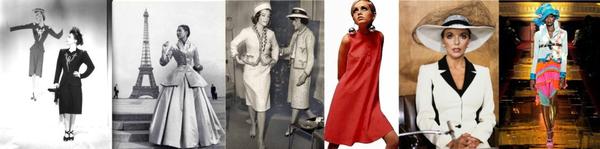
CoutureMarch 6, 2026 Does this word spring into your mind wild designs of fantasy, and often way over the heads of the rest of us who have our feet firmly on the ground? Or is it something that's for other people
and doesn't apply to us simply because we can't afford it or won't pay that kind of money for something that isn't durable?
That's the unfortunate reputation of couture, and often the image that practitioners promote because they don't want to answer to anything but their artistic intent. For me, that's a bunch of gobbledegook, and it actually shows those practitioners' huge insecurity about their abilities, skills, and end products.
But couture is really more
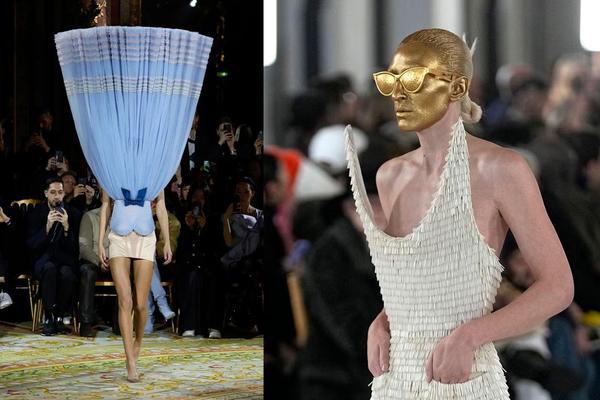
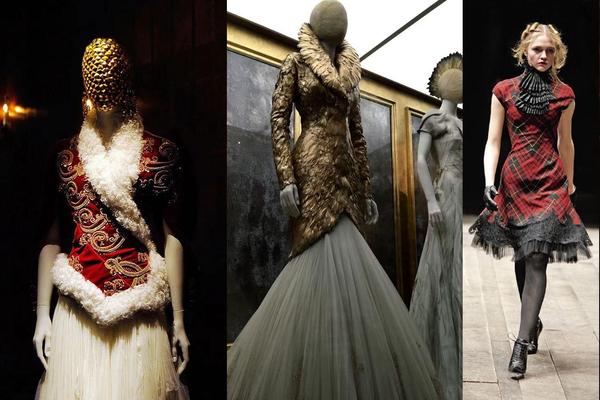
than that, and there are a lot more practitioners who are in it for the exact reason it was created - to offer a place for experimentation in design. Sometimes that experimentation got out of hand.
Yeah - the only person who would wear this are these models who are paid to wear them. They should be outlawed because they are so far off the mark, but then that defeats the purpose of the whole "couture" thing, so I guess they have to allow the stupid
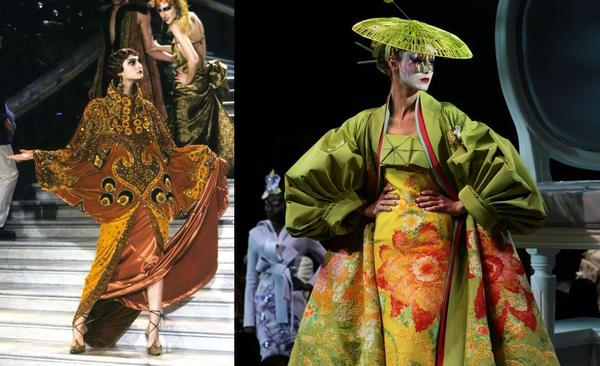
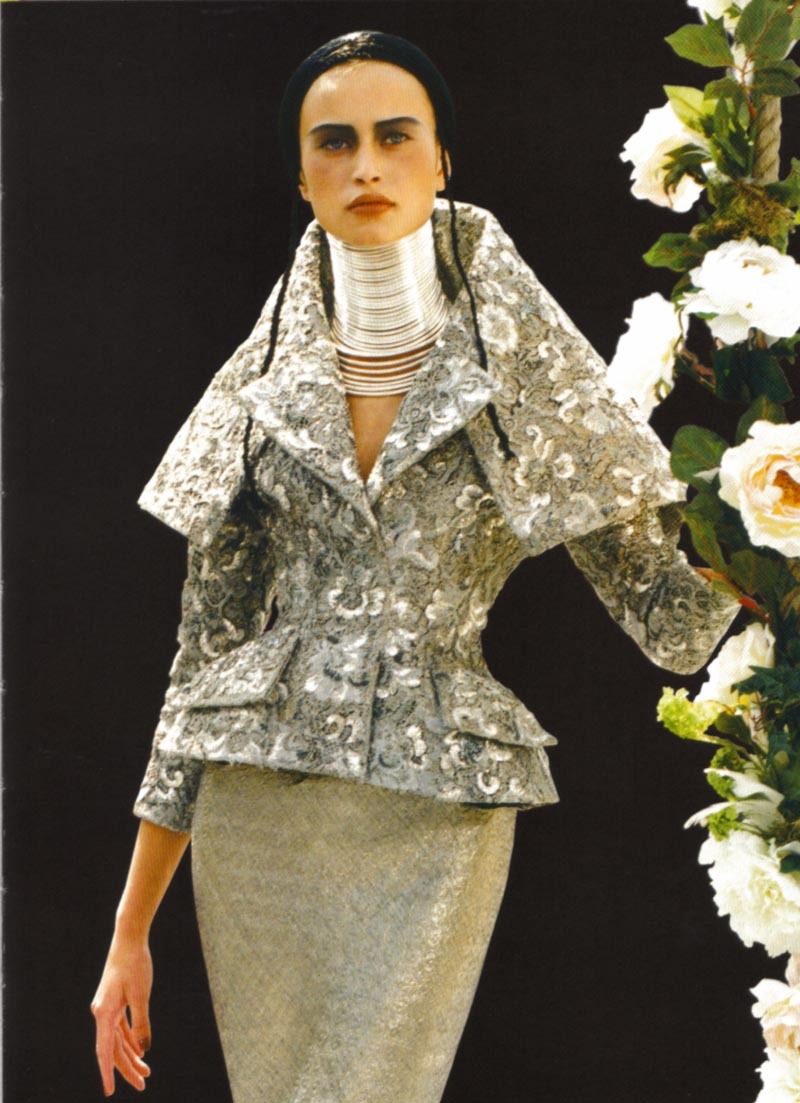
along with the beautiful. John Galliano at Dior - now I know this may look outrageous, but there are fantastic lines and proportions to follow
here that can lead to some beautiful work.
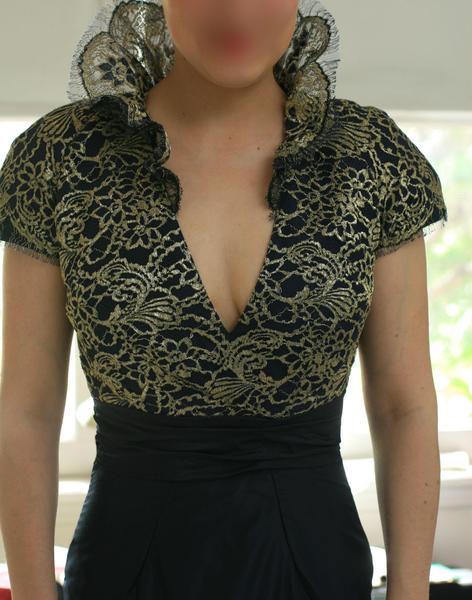
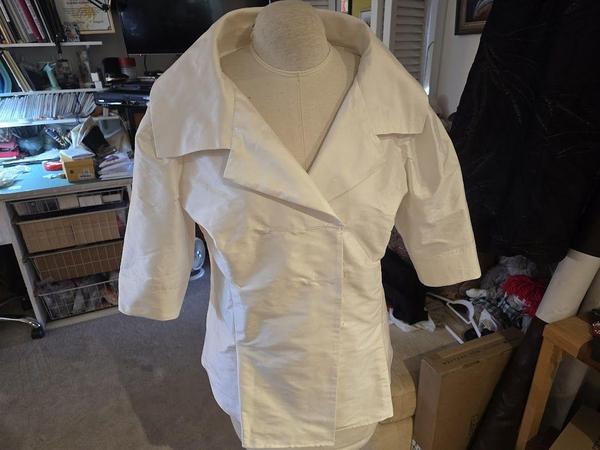
This led me to this design for a client...
Granted a lot more tamed down, but my client loved it and felt a lot like this gown was couture for her.
Alexander McQueen's Couture has tempered through the years, but it still has many ideas of lace, fur (or fuzz), painted objects arranged in a beautifully pleasing manner, and draping, gathering, and pleating of fabric, but most of all the silhouettes and
proportions that he employed should be studied closely for great inspiration. But couture doesn't have to be practiced only by the top designers in
Paris. Couture is for all of us to explore, and I want to encourage you all to practice your own form of couture.
That might simply be a different take on a collar, from something like this...
So that it's tamed down a lot, but the whole idea of a great collar is really fun and turns out very classic.
That's the whole purpose of couture. But couture is more than that. It's the complete personalization of a garment. That
means maybe one shoulder needs a little larger shoulder pad than another; maybe one leg is longer, so that side of the pants is longer; maybe you have longer arms than most, so you can make your sleeves as long as you like. These are just tiny little things that we can do that fall into the "couture" category.
There's always the grandiose gesture or design that seems to make headlines, but sometimes it doesn't. Sometimes it's like taking a classic design and
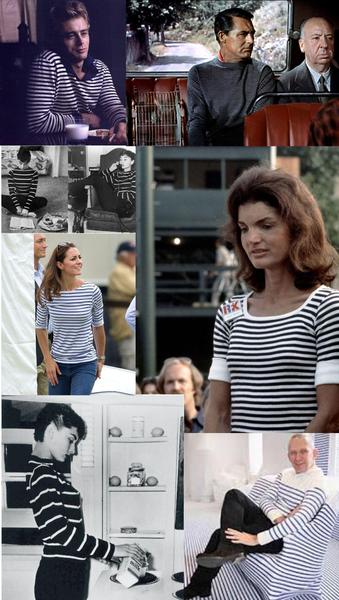
adding a little something extra to it. The Breton shirt, which is a classic all on its own....
The original French Naval Shirt (Breton for short) was designed so that if a man fell overboard, they could find him faster in this striped shirt. It has become a part of French (and English) dressing for so long that it's now a classic. BTW, the pic
with Hitchcock & Grant, upper right, is from "It Takes A Thief," and Grant's shirt has a very subtle, refined stripe!
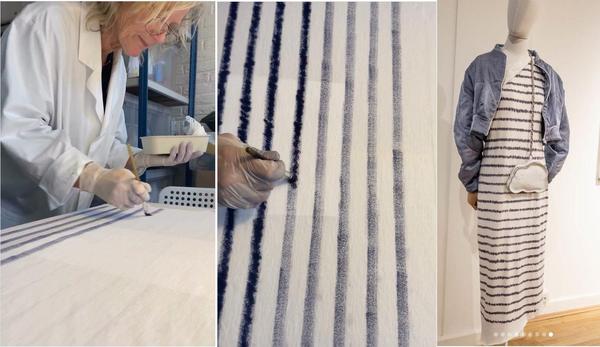
So how can you make a variation or improve upon something like that? Sometimes it takes watching another creative person to spark ideas for what you can do. I came across this on Instagram and thought it was so creative.
If you would like to see more click here. I'm not so hot on the dress itself, but I did love the stripe and
how they made it look Breton, but with a new flair.
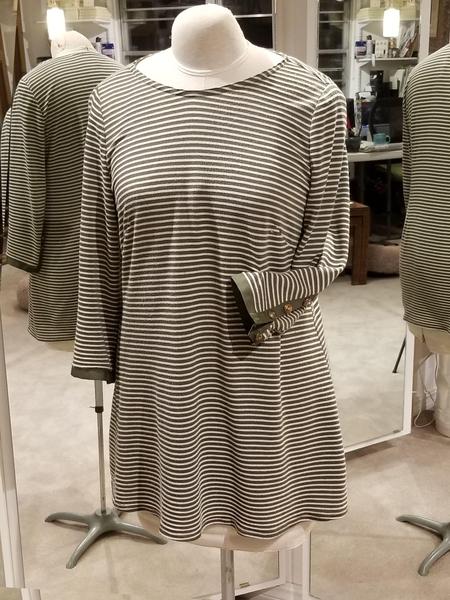
Here's another take on variation. This one is my core knit pattern, only instead of the navy/cream or white, I did cream/olive, being a person who never met a green she didn't like! I happened to have some great grosgrain ribbon that toned with the
olive in the stripe. In this case the "history" of the garment was what I used to vary this design. I took the French naval shirt (Breton), and did a bateau neckline (made famous by the Breton shirt because a sailor could easily remove the shirt to prevent constriction while working to be rescued). Then using the Chanel sleeve model, put a trim on the sleeves to make it look like it was a Chanel quilted jacket. The sleeves have a seam down the top of the sleeve. I
didn't use that, but did put the buttons on the cuff the way you would on a Chanel sleeve. So the Breton was French, the bateau neckline was French and the Chanel sleeve trim was French, but at different times. Since the neckline was bateau, I didn't need stretch to get it over my head, so I faced it with the grosgrain ribbon to offer stability across the shoulders.
Here are some ideas on how to vary a design to make it yours. This is a place to
start.
- Silhouette and Overall Shape can be in several areas
- Neck - collar is a great place to vary a design and go from completely casual to very formal.
- Shoulder - See the shoulder pad newsletter from last week, but remember the hang from the shoulder is vital. If you are messing around with this part of your pattern, just make sure the hang is good, and you'll be fine.
- Sleeves, arms, and lengths can make a simple variation that can add a lot to a garment. It's fun to mess around with closures on the cuff, too. Here are some of my favorite ideas, but you can collect your own, too.
- Lengths - of the top, the skirt, and the pants can all make variations that bring a whole new look to a garment.
- Blocking or creating sections of a garment, whether asymmetrical or symmetrical, brings on a whole new look.
- Fit and Customization - the most infuriating thing about RTW is that the pockets are like 4" deep, and
that's it. What can you fit into 4"? Practically nothing. My pockets are deep, especially deep enough to hold my phone with its apocalypse-protected case, which is huge on my phone. But any sort of customization - maybe you want a pocket on the inside of your sleeve, maybe you want to have one pant leg shorter than the other, whatever you like and need, customization is the center of couture. Customizing a garment is what couture is all about, and any thing we can
think of that would make our garment work better, we can accomplish, like the simple length of a pocket to the shape of a sleeve so that the upper part is larger than the lower part to provide a great fit, or that the shape of a skirt can altered from peg-shaped to flared - whatever we want. The examples here are endless, and I classify this "customizing" category as containing more than just fitting or comfort parts. It also includes those convenient and additional parts that make a
garment so special - like 8" deep pockets!
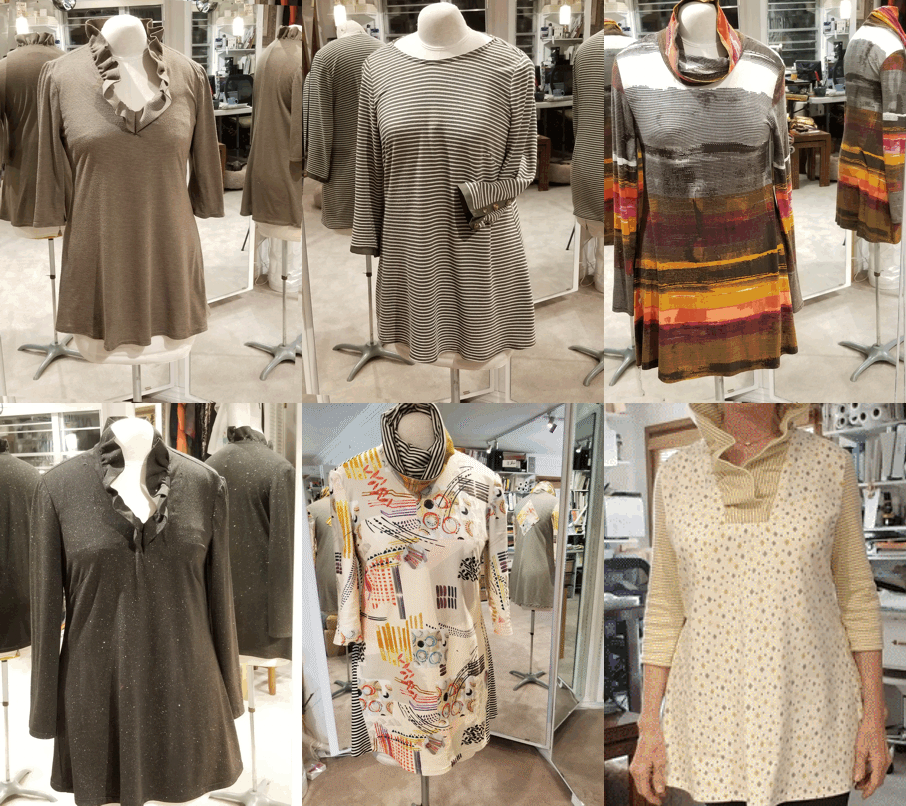
- Fabric, Material Selections, Color, and Pattern - of course, this is a major category that seems so simple that it can't be that important, but it is. A long time ago, when I was still mentoring under my teacher, I learned that the same pattern, made in a different fabric, was a completely different garment. I began experimenting with this and found it to be entirely true. At
first, I only made a green, a beige, and a black one.
But it suddenly occurred to me that I could do more than just sew a garment in different colors; by playing with fabrics and details, I could have a whole wardrobe from a single top pattern. In the collection above, I had mostly casual tops,
but the black (looks like charcoal grey with the ruffle neck) top, with shiny, pailletted specks in the fabric, was very low-key but obviously formal. I wore it to the opening of Carmen at the Met, and was probably the only person comfortable that night! Don't discount fabric as a serious design component or a simple way to vary a favorite pattern.
- Embellishments and Decorative Techniques - like the category above, this gets into a whole, huge area of design. Embroidery, even inserting different fabrics, color blocking, and even blocking with different types of prints. And as if to read my mind, Marcy Tilton has brought back the "Cool Combos" section of her website. I can't tell you how many times I've bought from that section, since Marcy does all the work for you. But I've also known them to be very helpful over the phone, when I've picked out a favorite print, and they have matched it with some great fabrics to get the colors and tones just right. This category can get so big, that you can literally get lost in
all the iterations of your basic look.
- Line, Details, and Construction Elements - On my core pattern, I really didn't mess too much with line, because through the years, I had perfected the silhouette and flattering fit. Today I'm experimenting more with woven trousers that have a killer hang and a shorter, more contained top. That top can be knit or woven, and I've kept to two woven patterns. Right now, I'm working with one knit pattern, but I haven't tried to vary
that too much. I know myself. Once I start wearing this, ideas will come. Working with a new silhouette is fun because there's a lot of experimentation involved, and I love that experimentation part of the process.
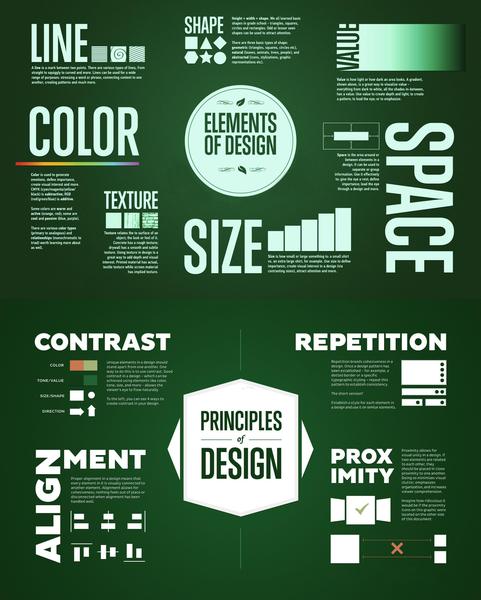
- Principles of Design Application - Including the elements, these two little gems have gotten me out of more messes and what may seem like unsolvable puzzles. They are truly magical. I've tried to keep these pertinent to clothing design, but the
truth is that these gems span through all artistic endeavors - music, a play or book, architecture, dance and many other aspects of artistic expression. And they are certain applicable to our designs.
The Elements are the parts of the design, while the principles help you put those parts together in a pleasing artistic way. They can be enormously helpful not only in getting you started, but also, if you do run into a problem, in helping you
identify what it is and work your way out of it. They look so simple and yet are so helpful.
Today, couture is different than what it used to be. When I was learning to sew (and design), couture was still very strictly upheld: the focus was on providing protection from the elements, with an artistic, flattering flair. The fashion magazines
held court over the designers, and many of them would have the fashion editors for a private "look" before their style shows so that they could explain what they were doing and get a positive review.
This was before the preponderance of social media. With the advent of the social media influencer, a whole new period began when fashion was inundated with whatever - the more outrageous, the better.
And with fashion editors like this (yes, she actually worked for Vogue Magazine Lynn Yaeger), it is hard to determine what was a joke and what was real. There were a few sane designers, Valentino, Karl Lagerfeld, Armani, Oscar and others of that ilk, but
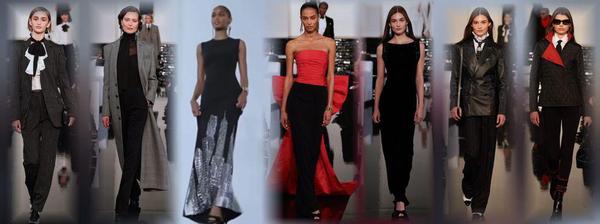
they have gone. Some of the others like Ralph Lauren, Thom Browne, The Row, Jason Wu and Zak Posen are also good, but you don't hear much about them. This is a shame, cause they all do beautiful looks that are flattering and enduring. Some newer names that have good bones are Haider Ackermann, and Sarah Burton who left Alexander McQueen and is at Givenchy now. But because of the plethora of "influencers" almost anyone can get publicized and can show their ideas with the
click of a key on the computer. There's no filter. This leaves the consumer in the lurches with styles that aren't always flattering, attractive and they sure aren't enduring or classic.
This is a serious problem for fashion these days. When you hardly have any filter, anything and everything gets through. Consumers are left being their own filter, and without much training, that's still not a lot of help. I mentioned above some designers that actually do
have good design, and what can happen is on AI, you do a search for a couple of those designers and AI should kick in to at least show you other designs of the same ilk or mention other designers.
Pinterest I still use Pinterest a lot to collect ideas. Pinterest
will cache the photo and even though the site comes down or the photo disappears, you can still see it on Pinterest, unless you delete the photo on your Pinterest account. This is heaven for me, cause when I hit a blank wall, and every artist does hit a blank wall eventually, Pinterest can be a huge help in getting the creative juices running again. Couture is being creative. It specifically refers to fashion design so that it may sound hoity-toity, but it's really not. It's the "creative" side of fashion. And that doesn't mean five sizes too big or clothing that is stretched so tight that it shows ever crevice of
your body. It mean what you want to have you can have. It actually cuts out the middle men in the fashion business, so that you can have the fit, look, style, silhouette, and tailor-made look that you like, that fits your lifestyle, and your wishes and dreams. While there is nothing like this available to others, (except the very rich), we can have that look. I constantly get looks and questions from people, "I love that blouse," or "Where did you get that coat?" and when
I tell them I'm a designer and I design my own clothes, they look at me with a grimace of disappointment. I would think that some designer somewhere would come up with a line of classic clothes, and make a killing.
In the meantime, I'll stick to my own coutured clothes!
|
This is a sad day - the loss of a classic tradition. Armani held the line
to fashion style that ...
Tracking a fashion trend isn't all that hard after seeing a few of them.
Living from Mid-Century Modern through Twiggy...
It's worth the time to look at these styles, particularly today as
there is a group of that wants to look....
This is the way fashion used to be -- pretty, flattering and I can't wait to make some of...
NOTE: There are some folks who can't get my email, or it's sporadic, or something is hinky. I will always respond to any of you who send a private message, whether it's about the topic of the week or something else. If you don't get anything
from me, it's probably because the [email protected] email is blocked, and even a private message can't get through. In that case, I'm on Instagram often, and you can always PM me at @sewingartistry.
As a precaution,
please ensure I'm in your email Address Book and check your spam, junk, and trash folders. Some email clients get extra excited when they see emails coming into the Inbox that go to many other receivers. They automatically think it's trash or spam, and it never makes it to the Inbox. I must constantly check my spam and junk folders to ensure I'm getting the emails I subscribe to.
To view in browser along with past emails, click here. We respect your email privacy. |
Tracking a fashion trend isn't all that hard after seeing a few of them.
Living from Mid-Century Modern through Twiggy...
It's worth the time to look at these styles, particularly today as
there is a group of that wants to look....
This is the way fashion used to be -- pretty, flattering and I can't wait to make some of...
NOTE: There are some folks who can't get my email, or it's sporadic, or something is hinky. I will always respond to any of you who send a private message, whether it's about the topic of the week or something else. If you don't get anything
from me, it's probably because the [email protected] email is blocked, and even a private message can't get through. In that case, I'm on Instagram often, and you can always PM me at @sewingartistry.
As a precaution,
please ensure I'm in your email Address Book and check your spam, junk, and trash folders. Some email clients get extra excited when they see emails coming into the Inbox that go to many other receivers. They automatically think it's trash or spam, and it never makes it to the Inbox. I must constantly check my spam and junk folders to ensure I'm getting the emails I subscribe to.
To view in browser along with past emails, click here. We respect your email privacy. |
|
|